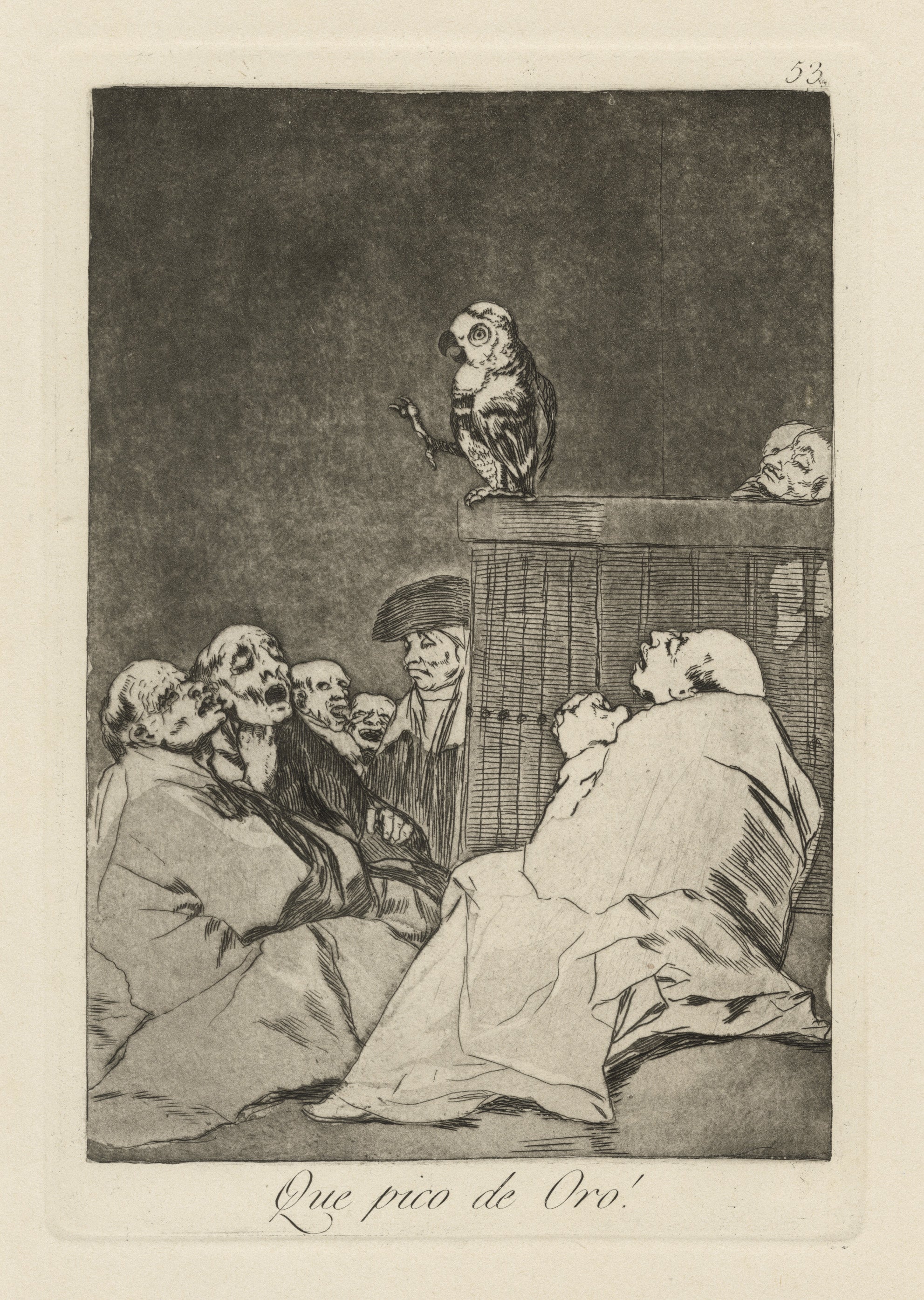
Que Pico De Oro!
What a golden beak!
This looks a bit like an academic meeting. Perhaps the parrot is speaking about medicine? However, don’t believe a word he says. There is many a doctor who has a ‘golden beak’ when he is talking, but when he comes to prescriptions, he’s a Herod; he can ramble on about pains, but can’t cure them: he makes fools of sick people and fills the cemeteries with skulls.
Etching with aquatint from Goya's most recogniseable suite Los Caprichos.
These etchings were published between 1881-1886 in an edition of 210 by the Calcografia for the Real Academia and are from the fifth edition.
The suite was first published in 1799 and Goya is thought to have sold only 27 copies before withdrawing it from circulation due to the Inquisition. Most of the remaining copies of the edition were alter purchased by King Charles IV of Spain. The work was an enlightened, tour-de-force critique of 18th century Spain, and humanity in general. The informal style as well as the depiction of contemporary society found in the Caprichos, makes them and Goya himself, a precursor to the modernist movement almost a century later.
Original: $2,732.11
-65%$2,732.11
$956.24Product Information
Product Information
Shipping & Returns
Shipping & Returns
Description
What a golden beak!
This looks a bit like an academic meeting. Perhaps the parrot is speaking about medicine? However, don’t believe a word he says. There is many a doctor who has a ‘golden beak’ when he is talking, but when he comes to prescriptions, he’s a Herod; he can ramble on about pains, but can’t cure them: he makes fools of sick people and fills the cemeteries with skulls.
Etching with aquatint from Goya's most recogniseable suite Los Caprichos.
These etchings were published between 1881-1886 in an edition of 210 by the Calcografia for the Real Academia and are from the fifth edition.
The suite was first published in 1799 and Goya is thought to have sold only 27 copies before withdrawing it from circulation due to the Inquisition. Most of the remaining copies of the edition were alter purchased by King Charles IV of Spain. The work was an enlightened, tour-de-force critique of 18th century Spain, and humanity in general. The informal style as well as the depiction of contemporary society found in the Caprichos, makes them and Goya himself, a precursor to the modernist movement almost a century later.