1 / 7
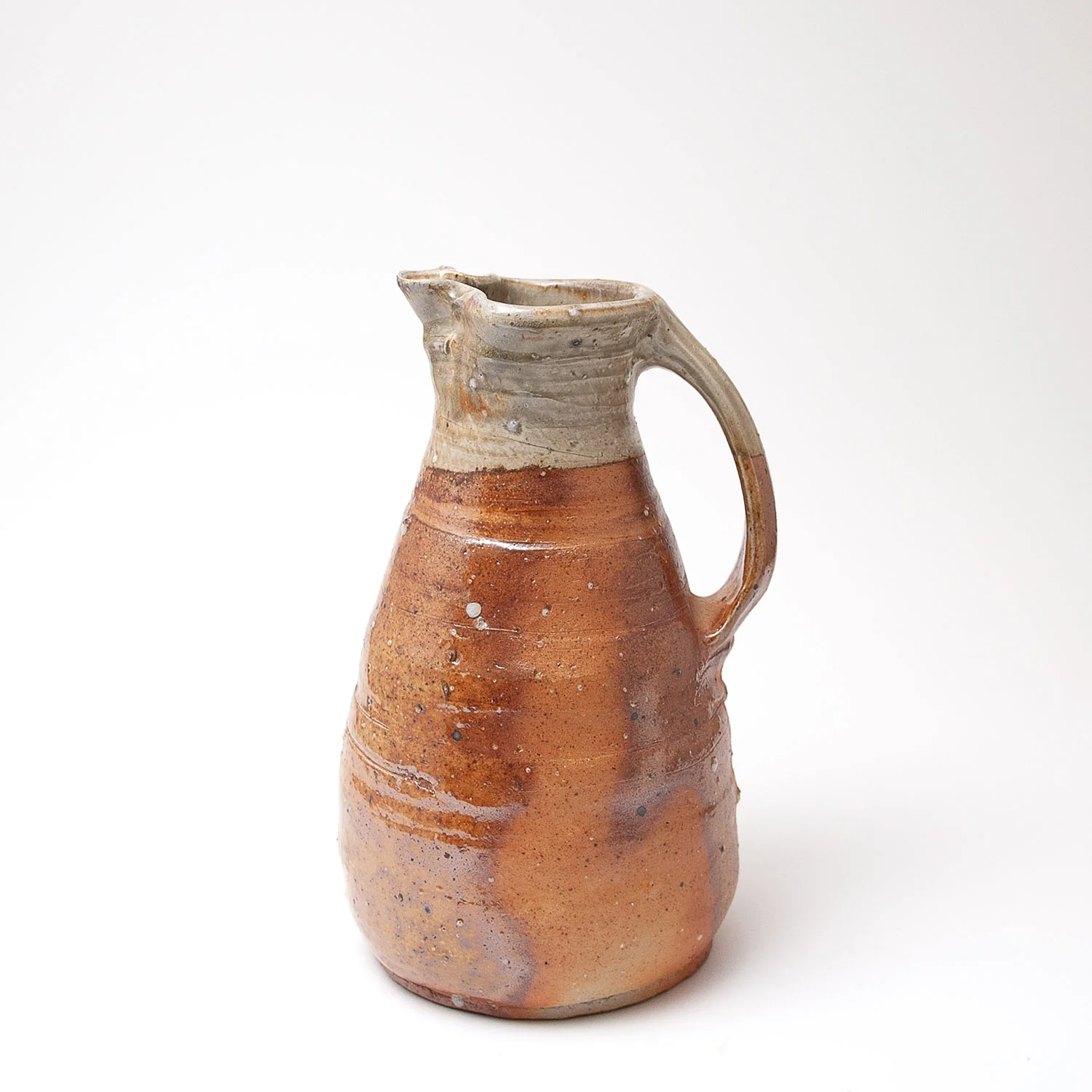
Large Bellarmine Type Bottle
Side stacked. Shino glaze. Natural ash glaze & shell scars
Shino glazes were first developed in Japan during the mid-1500s. They are distinguished by their large feldspar content, minerals that lower the melting point of the glaze mixture and help bond its distinct elements. They generally range from milky whites and pinks to deep reds, oranges and greys depending on their makeup and firing and can vary hugely in appearance from potter to potter. Of particular interest in Shino wares is the phenomenon of ‘carbon trapping’, where carbon is caught within the glaze during the firing, creating bubble-like spots or dark grey patches on the surface of the pot. Though it is sometimes described as a glaze defect, this blushing effect can be especially attractive and is often sought after by potters.
Natural ash glaze occurs in a wood fired kiln when ash particles carried around the kiln by the hot air and flames land and melt on the pots, often creating dramatic colour variations on their surfaces depending on their position in the kiln.
Scallop shells are used during firings to prevent pots sticking to the kiln and to each other. Burning away during the firing they leave behind fossil like scars. This pot was laid face down on top of the shells during firing. The fly ash settled on the exposed surface (what is now the 'back' of the pot), melting to form a natural ash glaze which upon cooling hardened into glassy rivulets .
Please contact us for delivery costs and further information
Shino glazes were first developed in Japan during the mid-1500s. They are distinguished by their large feldspar content, minerals that lower the melting point of the glaze mixture and help bond its distinct elements. They generally range from milky whites and pinks to deep reds, oranges and greys depending on their makeup and firing and can vary hugely in appearance from potter to potter. Of particular interest in Shino wares is the phenomenon of ‘carbon trapping’, where carbon is caught within the glaze during the firing, creating bubble-like spots or dark grey patches on the surface of the pot. Though it is sometimes described as a glaze defect, this blushing effect can be especially attractive and is often sought after by potters.
Natural ash glaze occurs in a wood fired kiln when ash particles carried around the kiln by the hot air and flames land and melt on the pots, often creating dramatic colour variations on their surfaces depending on their position in the kiln.
Scallop shells are used during firings to prevent pots sticking to the kiln and to each other. Burning away during the firing they leave behind fossil like scars. This pot was laid face down on top of the shells during firing. The fly ash settled on the exposed surface (what is now the 'back' of the pot), melting to form a natural ash glaze which upon cooling hardened into glassy rivulets .
Please contact us for delivery costs and further information
$1,789.67
Large Bellarmine Type Bottle—
$1,789.67
Product Information
Product Information
Shipping & Returns
Shipping & Returns
Description
Side stacked. Shino glaze. Natural ash glaze & shell scars
Shino glazes were first developed in Japan during the mid-1500s. They are distinguished by their large feldspar content, minerals that lower the melting point of the glaze mixture and help bond its distinct elements. They generally range from milky whites and pinks to deep reds, oranges and greys depending on their makeup and firing and can vary hugely in appearance from potter to potter. Of particular interest in Shino wares is the phenomenon of ‘carbon trapping’, where carbon is caught within the glaze during the firing, creating bubble-like spots or dark grey patches on the surface of the pot. Though it is sometimes described as a glaze defect, this blushing effect can be especially attractive and is often sought after by potters.
Natural ash glaze occurs in a wood fired kiln when ash particles carried around the kiln by the hot air and flames land and melt on the pots, often creating dramatic colour variations on their surfaces depending on their position in the kiln.
Scallop shells are used during firings to prevent pots sticking to the kiln and to each other. Burning away during the firing they leave behind fossil like scars. This pot was laid face down on top of the shells during firing. The fly ash settled on the exposed surface (what is now the 'back' of the pot), melting to form a natural ash glaze which upon cooling hardened into glassy rivulets .
Please contact us for delivery costs and further information
Shino glazes were first developed in Japan during the mid-1500s. They are distinguished by their large feldspar content, minerals that lower the melting point of the glaze mixture and help bond its distinct elements. They generally range from milky whites and pinks to deep reds, oranges and greys depending on their makeup and firing and can vary hugely in appearance from potter to potter. Of particular interest in Shino wares is the phenomenon of ‘carbon trapping’, where carbon is caught within the glaze during the firing, creating bubble-like spots or dark grey patches on the surface of the pot. Though it is sometimes described as a glaze defect, this blushing effect can be especially attractive and is often sought after by potters.
Natural ash glaze occurs in a wood fired kiln when ash particles carried around the kiln by the hot air and flames land and melt on the pots, often creating dramatic colour variations on their surfaces depending on their position in the kiln.
Scallop shells are used during firings to prevent pots sticking to the kiln and to each other. Burning away during the firing they leave behind fossil like scars. This pot was laid face down on top of the shells during firing. The fly ash settled on the exposed surface (what is now the 'back' of the pot), melting to form a natural ash glaze which upon cooling hardened into glassy rivulets .
Please contact us for delivery costs and further information