The Chamber Idyll
From The Carfax Portfolio 1904.
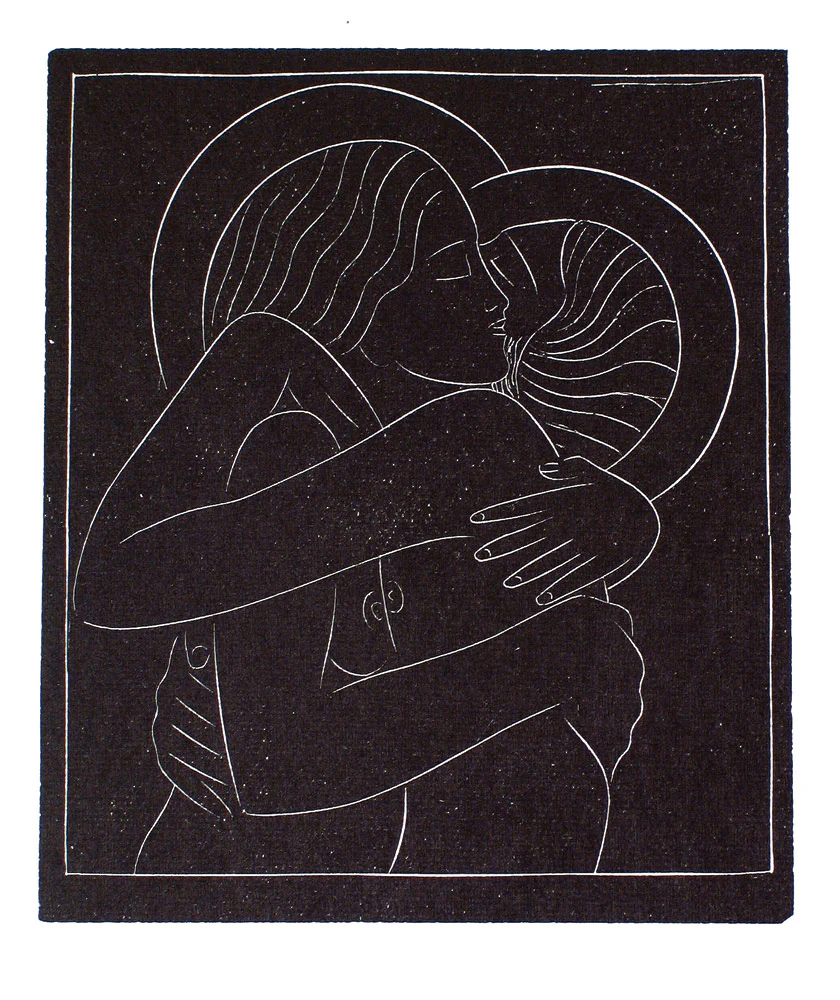
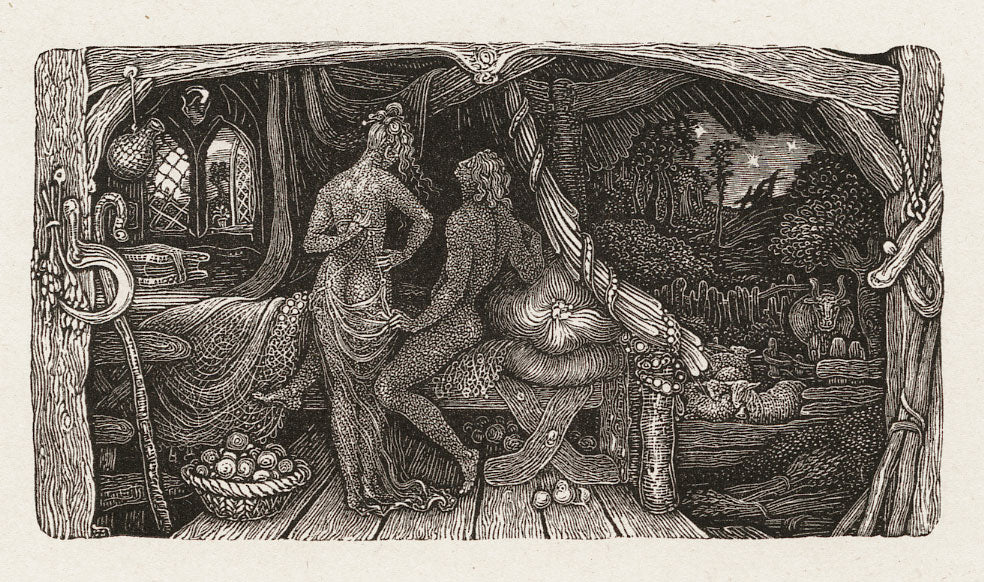
Appropriately the last of Calvert’s visionary works is his chef d’oeuvre; it is that fragrant little wood engraving, ‘The Chamber Idyll’, made in 1831, without doubt one of the supreme achievements of the art.
In this one work Calvert rose to unsurpassed heights of artistic conception and expression... We are eavesdropping on a moment of idyllic intimacy, the first delicious rapture of a honeymoon. It is a scene of peaceful love before sweet repose, after the labour of harvest and plough.
The original block for ‘The Chamber Idyll’ is now in the British Museum. It is, in itself, a perfect little work of art. It seems hardly credible that human hands could have made those fine incisions, which are as if a cobweb has been lightly dropped upon the surface of the wood. So fine, indeed, are the engraved lines that prints were made from it only with difficulty. It is in his blocks, when we are confronted with the actual physical fact of the cut wood, that we begin really to appreciate the close relationship of Calvert’s work to celature, which was, after all, an art of sculpting and graving.
Appropriately the last of Calvert’s visionary works is his chef d’oeuvre; it is that fragrant little wood engraving, ‘The Chamber Idyll’, made in 1831, without doubt one of the supreme achievements of the art.
In this one work Calvert rose to unsurpassed heights of artistic conception and expression... We are eavesdropping on a moment of idyllic intimacy, the first delicious rapture of a honeymoon. It is a scene of peaceful love before sweet repose, after the labour of harvest and plough.
The original block for ‘The Chamber Idyll’ is now in the British Museum. It is, in itself, a perfect little work of art. It seems hardly credible that human hands could have made those fine incisions, which are as if a cobweb has been lightly dropped upon the surface of the wood. So fine, indeed, are the engraved lines that prints were made from it only with difficulty. It is in his blocks, when we are confronted with the actual physical fact of the cut wood, that we begin really to appreciate the close relationship of Calvert’s work to celature, which was, after all, an art of sculpting and graving.
$4,944.92
Original: $14,128.34
-65%The Chamber Idyll—
$14,128.34
$4,944.92Product Information
Product Information
Shipping & Returns
Shipping & Returns
Description
From The Carfax Portfolio 1904.
Appropriately the last of Calvert’s visionary works is his chef d’oeuvre; it is that fragrant little wood engraving, ‘The Chamber Idyll’, made in 1831, without doubt one of the supreme achievements of the art.
In this one work Calvert rose to unsurpassed heights of artistic conception and expression... We are eavesdropping on a moment of idyllic intimacy, the first delicious rapture of a honeymoon. It is a scene of peaceful love before sweet repose, after the labour of harvest and plough.
The original block for ‘The Chamber Idyll’ is now in the British Museum. It is, in itself, a perfect little work of art. It seems hardly credible that human hands could have made those fine incisions, which are as if a cobweb has been lightly dropped upon the surface of the wood. So fine, indeed, are the engraved lines that prints were made from it only with difficulty. It is in his blocks, when we are confronted with the actual physical fact of the cut wood, that we begin really to appreciate the close relationship of Calvert’s work to celature, which was, after all, an art of sculpting and graving.
Appropriately the last of Calvert’s visionary works is his chef d’oeuvre; it is that fragrant little wood engraving, ‘The Chamber Idyll’, made in 1831, without doubt one of the supreme achievements of the art.
In this one work Calvert rose to unsurpassed heights of artistic conception and expression... We are eavesdropping on a moment of idyllic intimacy, the first delicious rapture of a honeymoon. It is a scene of peaceful love before sweet repose, after the labour of harvest and plough.
The original block for ‘The Chamber Idyll’ is now in the British Museum. It is, in itself, a perfect little work of art. It seems hardly credible that human hands could have made those fine incisions, which are as if a cobweb has been lightly dropped upon the surface of the wood. So fine, indeed, are the engraved lines that prints were made from it only with difficulty. It is in his blocks, when we are confronted with the actual physical fact of the cut wood, that we begin really to appreciate the close relationship of Calvert’s work to celature, which was, after all, an art of sculpting and graving.